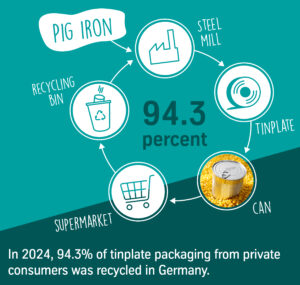

Germany has set a new benchmark for sustainable packaging, with 94.3% of tinplate from private consumption recycled in 2024, according to latest industry figures.
The recycling rate for total tinplate consumption also reached a peak of 92.5% last year, maintaining stability at around 90% since 2006. The figures were published by the Gesellschaft für Verpackungsmarktforschung (gvm) in its annual recycling report for packaging.
"Tinplate is one of the leading materials in terms of recyclability and the epitome of true circularity, as it can be recycled almost 100% over and over again without any loss of quality," said Clarissa Odewald, chief executive of thyssenkrupp Rasselstein GmbH, Germany's only tinplate manufacturer. "This makes tinplate an important building block for a resource-efficient future."
The material's unique properties enable tinplate cans, twist-off closures and crown corks to be recycled into new high-quality steel products – from wind turbines and car components to bicycle parts and fresh packaging. Steel can be melted down repeatedly and processed with pig iron from blast furnaces into crude steel, creating a closed material cycle.
Growing consumer awareness
The 1.5 percentage point increase in the recycling rate amongst private consumers compared to the previous year demonstrates growing awareness of proper waste disposal practices.
"This is a very positive development for the environment and a way to conserve primary resources," Ms Odewald said. "However, we must not rest on our laurels, but should continue to work on improving the rate."
Since 2021, thyssenkrupp Rasselstein has supplemented dual system activities by educating consumers about packaging materials and waste separation through its website and Instagram channel, weissblech-kommt-weiter.de, which provides information on correct disposal of tinplate packaging and food can usage.
The company operates two return systems to ensure effective recycling: DWR (Deutsche Gesellschaft für Weißblechrecycling mbH) for the private sector and Kreislaufsystem Blechverpackungen Stahl GmbH for commercial and industrial sectors.
thyssenkrupp Rasselstein's Andernach facility, the largest of its type worldwide, has an annual production capacity of up to 1.5 million tonnes of packaging steel, serving international customers across food, beverages, aerosols and industrial packaging markets.
Germany achieves record 94% tinplate packaging recycling rate